 |
|
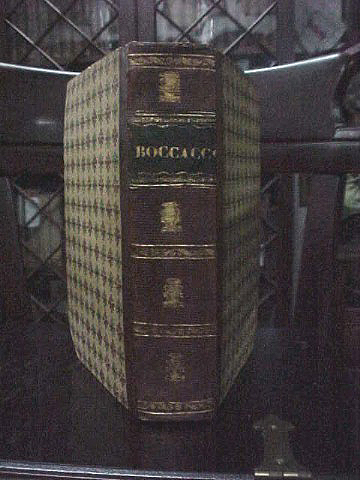 |
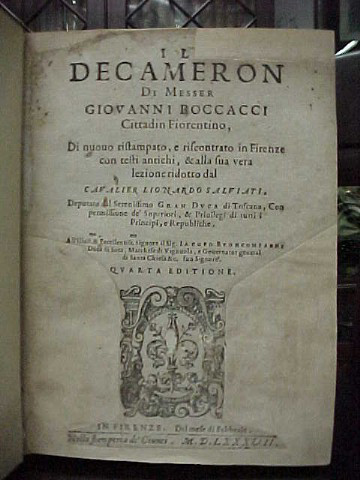
Il
Decameron, Boccacio’s
most famous work, was penned between 1351
and 1353. The title comes from the Greek deca
meaning ten, and hemera meaning day which
refers to the framework of the story. Set
in the year of the Black Death [1348], seven
ladies and three gallants meet in a Florentine
Church where they decide to flee the city
to the hills of Fiesole. There they entertain
themselves by recounting stories all of the
ten days. The Decameron is composed of more
than one hundred novelle composed of anecdotes,
fabliaux, folk stories and fairy tales–all
of ancient lineage for the contemporary audience
of the fourteenth century.
The compilation includes many influential
and celebrated stories that were recycled,
especially by Shakespeare. “Bernabo of
Tenou was the plot of Cymbeline; “Gillette
of Narbonne” of All’s Well that
ends well. As late as 1820, John Keats used
Isabella or the Pot of Basil as the substance
of his poem as well as the title.
Lesser
known than his contemporary and companion
Petrarch, Boccacio nevertheless is credited
with the initial introduction of their style
and content, the first in the Italian or European
canon of literature. He is entitled to a place
beside Petrarch as founder of the Italian
Renaissance.
|
|
The
Giunti publishing family were the great rivals
of the Aldine Press as the Giunti aggressively
captured large portions of the lucrative Italian
governmental and Church's printing business.
Their printing enterprise spread from Italy,
to Spain and France between 1489 to 1628.
From their base in Florence and Venice, family
members set up printing presses in Burgos,
Salamanca, Madrid, Valladolid, Lerma and Lyons.
16
p.l., 585, [79] p.
Mounted title page; Signatures: * 2, 3, 4
^ [8]; ** 2, 3, 4 ^ [8]; a 2, 3, 4 ^ [8];
b 2, 3, 4, ^ [8]; c 2, 3, 4 ^ [8]; d 2, 3,
4 ^ [8]; e - z 2, 3, 4 ^ [8] / aa, bb, cc
- hh, 2, 3, 4 ^ [8]; ii [misbound] r 497 v
498; ii 2 [499]; ii 3, [501]; ii 3 v [506];
[ii 4 r] 507; [ii 4 v] 504; [ii 5 r] 505;
[ii 5 v] 502; ii 4 r [503] v [508]; [ii 6
r] 509 : kk, 2, 3, 4 ^ [8]; ll, mm, 2, 3,
4 ^ [8]; nn 2, 3, 4 ^ [8], [nn 8 verso] 176;
oo recto [75] verso [578];] oo 2, oo 3 ^[6]:
oo 5 r [585] v, register followed by colophon
with place printer & date; oo 6 recto
[blank], verso, printer’s device. end
of pagination. // [79]pp., Tavola Sopra Il
Libro Chiamato Decameron Proemio: signatures:
pp 2, 3, 4 ^ [8]; qq - ss 2, 3, 4 ^ [8]; tt
2, 3, ^ [6]: tt 5 r: errori; tt 5 v errori
con’t, followed by register, colophon
with place, printer & date; tt 6 r [blank],
v, earlier printer’s device.
References
: Adams B174.
|
| |
 |
|
The
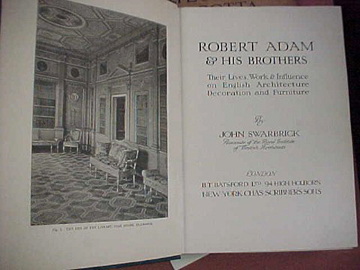
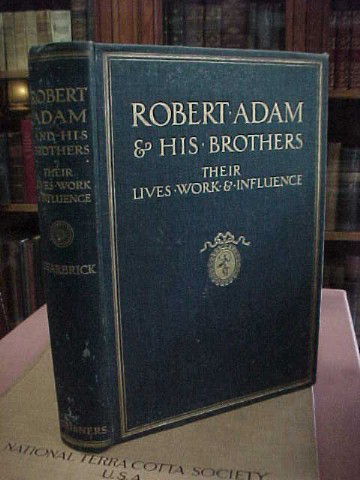
quintessential Robert Adam Swarbrick, John.
Robert Adam and his Brothers: Their lives,
work and influence on English architecture,
decoration and furniture. London: B.T. Batsford,
1915. Quarto, blue cloth with gilt title on
spine and cover. Frontispiece, x, 316pp, 224
illustrations (b&w photographic plates.
A well produced book which reviews in considerable
detail the work of, particularly John Adam,
and the influence he and his brothers had
upon all aspects of English architectural
and decorative achievements. Comprehensive
study, richly illustrated, remains the standard
work on Scottish architect Robert Adam whose
architecture informed fashionable taste of
the 18th century.
$ 225
|
|
 |
19th
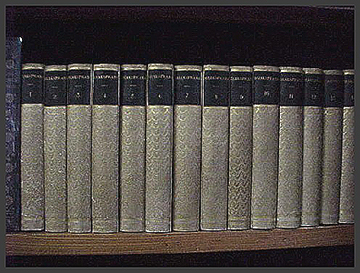
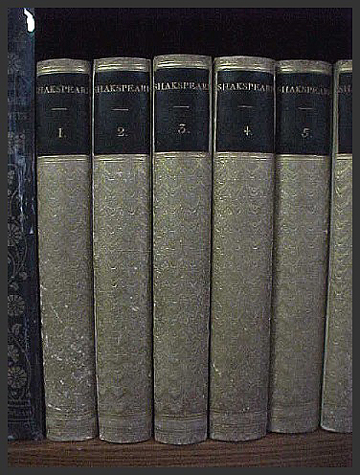
Century edition of Shakespeare in Fine Binding
Shakespeare, William. The Plays and Poems
of William Shakespeare with a Life, Glossarial
Notes, and One Hundred and Seventy Illustrations
from the Plates in Boydell's Edition. Edited
By A.J.Valpy. In fifteen volumes. London:
Printed and Published by A.J.Valpy Red Lion
Court, Fleet Street, 1832-1834. 12mo in fifteen
volumes. Engarved frontispiece portraits in
Volumes I [engraved by Freeman after the Chandos
portrait] and XV [by T. Starling] and 170
outline plates executed on steel, in the first
style from Boydell’s 1802 edition. Bound
in 3/4 vellum over marbled boards, marbled
endpapers, spines elaborated stamped in gilt
with binder’s morocco pastedown stamped
in gilt w/ author and volume; t.e.g. A fine,
tight set of an important early 19th century
collection of the collected works, fully illustrated.
$ 2350
|
|
 |
| |
|
|
|
|
|
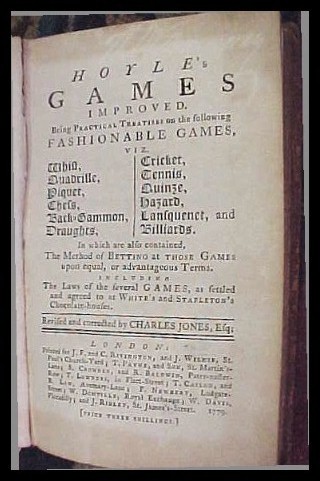
Edmund
Hoyle (1672- 1769). HOYLE'S GAMES IMPROVED
Being a Practical Treatise on the following Fashionable
Games, viz. Whist, Quadrille, Piquet, Chefs, Back-Gammon,
Draughts, Cricket, Tennis, Quinze, Hazard, Lansquenet,
and Billiards; In which are also contained The
Method of Betting at those Games upon equal, or
advantageous Terms; Including The Laws of the
several Games, as settled and agreed to at White’s
and Stapleton’s Chocolate-houses: Revised
and Corrected by Charles Jones, Esq; London: Printed
for J. F. and C. Rivington, et al. 1779. 12mo.
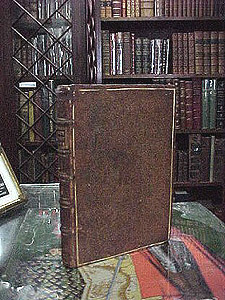
Contemporary
calf. xiii, 294 pp, 3 leaves publishers advertisements
at end. Front cover detatched, spine worn through
to sewings, first signature loose, otherwise
a tight copy of a very scarce work. Heraldic
device bookplate of Rev. Francis Thackeray pastedown
on interior front board. Early ink signature
above (illegible). Signature at top right of
first flyleaf in flourished hand WM Thackeray.
Britisher Edmund Hoyle died at the advanced
age of 90 in 1769. In 1746 Hoyle published a
book consisting of a short treatise and rules
of five games. Called Hoyle’s Games, it
was the only book he ever published. The instant
success of his work fostered spurious editions
wherein authors’ appended Hoyle’s
name to their own books, a practice that continues
today. After Hoyle's death, the book was taken
over by Charles Jones, who added instructions
on cricket, tennis, billiards, and other "fashionable
games." Hoyle was the first person to write
scientifically about whist, and offered odds
for betting in all sports.
|
| |
|
|
|
|
|
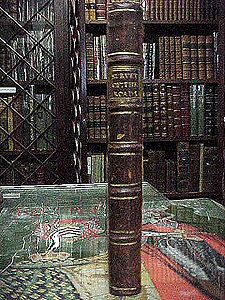 |
BRITTANIA
ye 4th edition
John Owen and Emanuel Bowen.
Britannia Depicta; or, Ogilby Improv'd; Being
a Correct Copy of Mr. Ogilby's Actual Survey of
all ye Direct and Principal Crossroads in England
and Wales: Wherein are exactly Delineated &
Engraven, All ye Cities, Towns, Villages, Churches,
Seats &c. scituate on or near the Roads, with
their respective Distances in Measured and Computed
Miles. And to render this Work universally Useful
& agreeable.are added.1. A full & particular
Description & Account of all the Cities, Borough-Towns,
Towns-Corporate &c. their Arms,.by Ino. Owen
of the Midd: Temple Gent... Lastly Particular
& Correct Maps of all ye Counties of South
Britain; with a Summary description of each County..ye
4th edition. by Eman. Bowen, Engraver. London,
Printed for & Sold by Thom. Bowles & I.
Bowles, 1724.
8vo., contemporary mottled calf, boards and banded
spine ruled in gilt, binders title pastedown intact.
Armorial bookplate to front with motto: Go, and
do thou likewise.
|
|
(Brittania
continued...)
Fourth octavo edition. 2ff, [4], 273pp; engraved
throughout, including 54 engraved maps and numerous
coats of arms; numbered plates of engravings printed
on two sides, beautifully executed by Emanuel
Bowen (d. 1767), and largely based on the original
work, without substantial alterations Near fine.
$ 2,500.00
John Ogilby (1600-1676) produced two works in
folio, both issued in 1675, the Britannia, volume
the first, containing both text and maps, and
the itinerarium angliae from which the main portion
of the text is omitted. The first major road map
survey of England and Wales, considered one of
the greatest works of cartography ever published.
In 1719, owing to its immense popularity and utility,
various works containing reductions of the maps
were issued, among them the Britannia depicta
of which this is the fourth edition. |
| |
|
|
|
|
|
|
|
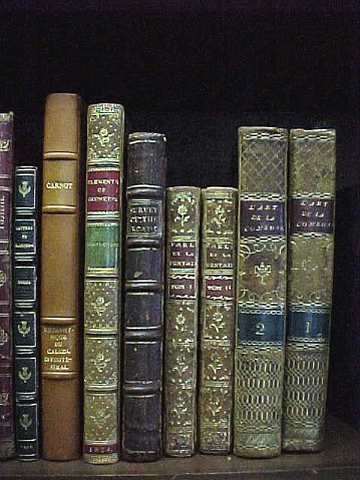
18th
century Carnot La Fontaine
|
|
16th
century Fine Bindings
|
| |
|
|
|
|
|
|
|
|
-
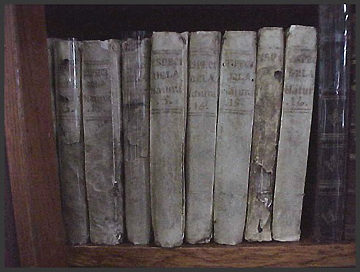
A selection of 16th and 18th books -
click for enlarged image
and details
|
|
 |
|
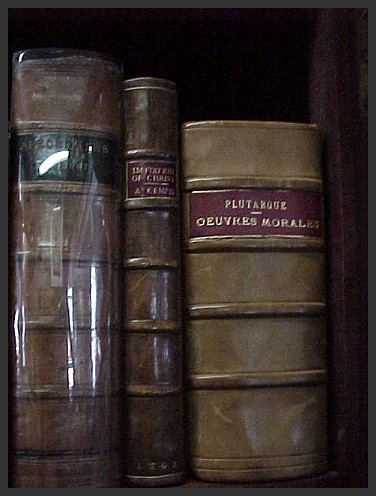
18th
century Vellum
|
|
| 19th
century Fine Bindings |
|
|
|
|
|